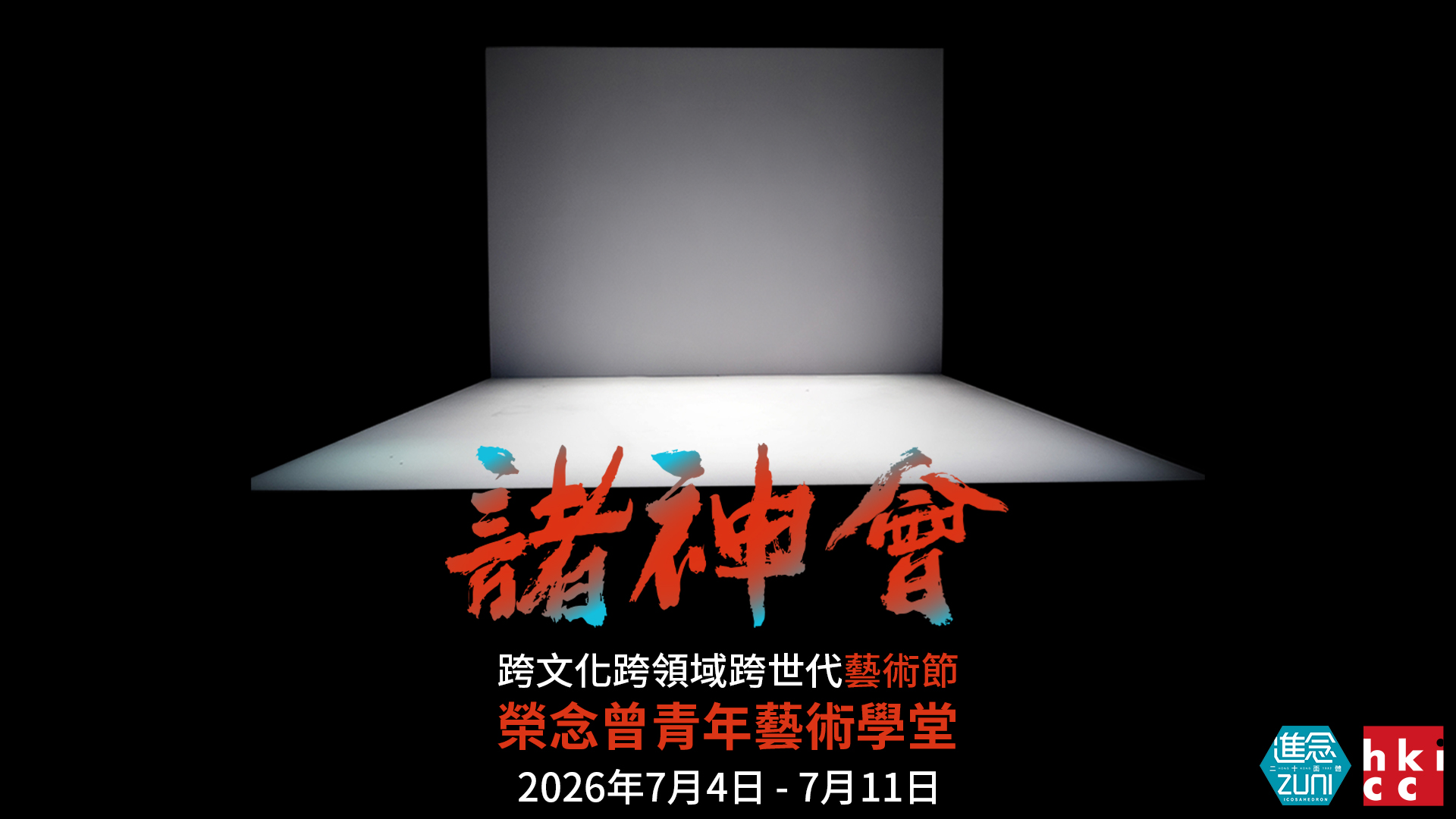
Dates: July 5 – July 9, 2026
Venues: Multi-media Theatre & Studio Theatre, HKICC Lee Shau Kee School of Creativity
From Performance to Dialogue
These five “One Table Two Chairs” forums are hosted by Singaporean intercultural theatre director Liu Xiaoyi and curated by architecture and culture scholar Melody Yiu. Artists and participants from diverse backgrounds are invited to explore questions related to art festival, arts education, cultural institutions, and arts practice through an intercultural dialogue.
01 | Arts Festivals -How do experiments in the forms and content of cultural exchange inspire future arts festivals?
02 | Creative Education – How can reforms and innovations in educational institutions cultivate independent and forward-looking values?
03 | Cultural Insitutions – How do cultural institutions recognize and challenge conservative tendencies within their own organizational culture?
04 | Arts in Practice – How do arts practitioners respond to external forces?
05 | Visionary Symposium | On Academies and Festivals / Critique and Challenge
Rather than seeking definitive “answers,” each forum aims to spark collision between distinct experiences and perspectives, reimagining the possibilities of future festivals, education, and cultural practices.
Moderator: Wong Yuewai
Speakers: Makoto Matsushima, Park Hobin, Rady Nget, Xiao Xiangping
Respondent: Melody Yiu, Liu Xiaoyi
Date & Time: Sunday, 5 July 2026 | 17:00–18:30
Venue: Multi-media Theatre, HKICC Lee Shau Kee School of Creativity
A performing arts festival is an occasion when artists from different regions gather over an intensive period to showcase and exchange their work. An example is the Hong Kong Arts Festival founded in 1973, which was established to enrich cultural life by bringing international productions to local audiences.
Today, however, as international travel and social media became the norm, it is no longer difficult to access any types of artworks on YouTube or commercial streaming platforms. Festivals have gradually an industry and a city-branding tool, as a form of cultural consumption and producing spectacles and blockbuster programmes aimed at mass-market sensation. This brings us to a basic question: What is an arts festival and who is it for?
To rethink the role of festivals in cultural exchange, the focus needs to from showcasing work to exchanging ideas and values through practice. The festival is inherently an open platform with interaction and exchange on and off stage, to be understood as a field of
“happening.” Artists and audiences alike are inevitably confronted with cultural and intellectual differences, which requires an effort to understand one another with an open mind. Such is the foundation of cultural exchange and development: divergent perspectives are set to collide, generating new ideas and unexpected creative outcome.
In this sense, the festival becomes a site for prototyping and testing new ideas or artistic forms. It also challenges the boundaries of individual creative practice and established institutional logics, such as funding expectations, programming tendencies, and audience assumptions. When the festival centres on experimentation of form and content, what kind of artistic, personal, and social knowledge can emerge?
Therefore, the key question for future development of festival would be: What are the essential conditions for experimentation and exchange to happen?
On Temporality: What is the legacy of an arts festival? How do we translate incidental exchanges into sustained
development?
On Scale: When focusing on interaction and experimentation, are more intimate settings more effective? How do we work across different scales and find room for experimentation?
On Agency: When cultural exchange is constrained by institutional resources, how can cultural practitioners break through the limitations to collaborate?
Moderator: Liu Xiaoyi
Speakers: Ren Jiale, Yang Junfeng, 1–2 students from Singapore (NAFA), 1–2 students from Hong Kong
Respondents: Makoto Matsushima, Park Hobin, Rady Nget, Melody Yiu
Date & Time: Monday, 6 July 2026 | 14:00–16:00
Venue: Studio Theatre, HKICC Lee Shau Kee School of Creativity
Contemporary educational institutions are caught in a tension: while it champions creativity and innovation, the actual operations is governed by performance metrics and rankings. The result is an skills-driven vocational training model that is justified by its market utility. In this system, creative knowledge and critical inquiry became undermined by an instrumental role of education in society.
Especially for arts and creative education, skills and technique should be a means rather than an end. As the canonical Bauhaus school argued, craft is the fundamentals for artists and designers’ development, and skills training should be placed within a broader framework that connects technical “how” with critical “why.” Yet many institutions nowadays tend to focus on the “how” question and thereby weakening the critical dimensions of comprehension, expression, and reflection. Are we merely preparing workers for the industry, or can we nurture creative thinkers with sensibility, imagination, and criticality? Under the pressure from efficiency and performance, do we have the time and space to teach and learn beyond static skills?
This reflection on time and resources is inseparable from arts education’s position within the wider cultural ecosystem as the pipeline for future practitioners. The industry repeatedly signals demand for technical workers, institutional naturally gravitate towards perceived labour-market needs to align student pathways with teaching considerations. Therefore, to rethink what is a school is to challenge existing assumptions and ask what the future cultural ecosystem and job market should look like.
The idea of a reflexive lab can offer an alternative imagination for future educational institutions. It prioritizes experimentation, values trial and error, and embrace unexpected outcomes rather than linear skill-building. Bringing this model into arts education shifts the question from “what skills should be taught” to “how do we build an environment that cultivates creative sensibility and critical agency?” By connecting skills training with critical reflection, it becomes a place where students take ownership of their experimentation, and teachers become co-investigators rather than authorities with a definitive answer.
The school can then function as a perpetual think tank, subject to reviews and iterations. By valuing empathy, comprehension, expression, and criticality, the focus would be how ideas are communicated, what assumptions shape them, and how the curriculum itself can evolve in response. The language of STEAM justifies the integration of arts into future technology-based education. But for the forward-thinking creative institution, the question might be reversed: What pedagogical tools and structures are needed to let creative education drive future technological innovation?
On Evaluation: What kind of assessment system can reflect the value of creative process? What evidence of
learning outcomes should we look for?
On Collaboration: How to design a pedagogical framework that allows students, teachers, and arts practitioners to co-investigate artistic questions beyond preconceptions of individual roles?
On Progression: Looking at an artist’s growth over time, how do we disaggregate learning into meaningful stages and scaffold it into a sustained journey of creative experimentation?
Moderator: Melody Yiu
Speakers: Danny Yung, Liu Xiaoyi
Respondents: Makoto Matsushima, Park Hobin, Rady Nget
Date & Time: Tuesday, 7 July 2026 | 14:00–16:00
Venue: Studio Theatre, HKICC Lee Shau Kee School of Creativity
In contrast to the ephemeral festival and the cyclical school environment, public cultural institutions are often seen as the stable anchors in a volatile cultural ecosystem. Many public cultural institutions and emerged and expanded in the late twentieth century have, as stewards of public or philanthropic resources, tasked to support artistic creation and cultural exchange. Through funding, management, and dissemination, these institutions stabilize artistic production into an organized system, translating individual creative wills into collective actions.
However, this stability is built on procedures and norms shaped by particular agendas and values, which create both visible and invisible mechanisms that can limit creative freedom and experimentation.
This raises a basic question: What frameworks and boundaries are built into the organizational culture of these long-standing cultural institutions? And as cultural practitioners who operation within them to varying degrees, how aware are we of the inherited and internalized “house rules”?
Institutions are defined by shared values, beliefs, and behaviours, reinforced through operational design and decision-making processes. More often than not, the pursuit of value alignment leads to a preference for consensus, encouraging outcomes that are agreeable to most stakeholders while filtering out content that appears to be non-conforming. When consensus becomes the overriding goal, creative work tends to repeat already accepted forms, structures, and concepts, leaving little room for critical reflection on differences and exploration of the unknown.
We are constantly faced with practical constraints that could hinder the transformation and implementation of creative ideas, such as budgeting mandates, programming cycles, spatial use, and personnel structure. So how can critical thinking be cultivated within conservative institutional setting? When organizational culture values efficiency and technical output as a representation of consensus, it becomes difficult for cultural practitioners to voice out difference and break through inherited frameworks. Only when there is sufficient tolerance for disagreement and openness to conflicting values, can creativity emerge within the established system.
Therefore, the last and crucial question would be: As we are embedded within organizational culture, how can we prompt the institution to confront their own boundaries and limitations, and consciously design pathways to transcend them?
On Scale and Resources: Should cultural institutions remain small to preserve autonomy, or should they expand to secure more resources? What is gained and lost in each choice?
On Infrastructure: What internal structures, such as funding models, rehearsal or residency spaces, board of governance, and evaluation tools are needed to support long-term experimentation rather than one-off opportunistic projects?
On Engagement: Beyond standard satisfaction surveys, how can artists, administrators, and audiences genuinely participate in questioning and reshaping organizational culture?
Moderator: Melody Yiu
Speakers: Park Hoin, Makoto Matsushima, Rady Nget, Ren Jiale, Yang Junfeng, 1–2 students from Singapore (NAFA), 1–2 students from Hong Kong
Respondents: Liu Xiaoyi
Date & Time: Wednesday, July 8, 2026 | 14:00–16:00
Venue: Studio Theatre, HKICC Lee Shau Kee School of Creativity
Artistic creation is often imagined as a personal and internal affair, yet it can never be fully detached from surrounding conditions. Today, several intersecting forces are especially apparent in shaping the development of art and culture: policy, market, media, and technology. They do not merely set the stage for artistic creation but actively forming the conditions of cultural production: who can create, where, and with what resources, and consequently define the value system of art and culture itself. This poses an immediate question for artists and cultural practitioners: Do we comply, resist, redirect, or can we rewrite the script?
Politics and policy – Cultural policy operates through both short-term project funding and long-term infrastructural support. Yet most policies nowadays still focus on incidental grants, leaving practitioners precarious to build sustainable working conditions and having to depend on policy theme and expectation in form and content.
Market and audience – When art enters the market, audience interest and industrial mechanisms exert structural pressure on artistic approach and presentations. Is there room for niche practices, or are they inevitably pushed to the margins of visibility and support?
Media and technology – Emerging media technologies have already transformed conventional aesthetic, while digital platforms and social media further intensify the appeal of spectacle and shareable experiences. They have the power to decide what is deemed worthy of public attention and constructing dominant discourse. As everyone is drawn to visibility and internet traffic, how do artistic practice maintain integrity and stay true to its craft?
To be an arts and cultural practitioner today can feel more difficult than ever, as we find ourselves in the midst of overlapping political, economic, social, and technological pressure. But this is not entirely new: art has never been isolated from society. The issue is therefore not the existence of external forces, but how we turn the it into material to work with and against. When pressure accumulates and space closes, cynicism can be a refuge from disappointment, but it would also diminish our imagination of possible futures. So how can we confront these forces without retreating into cynical,
private expressions?
Besides these structural forces, we are also living through compounding global and local crises: political volatility, social inequality, ecological collapse, and more… These conditions inevitable shape our creative directions. For this forum, it may be useful to ask not only what forces are affecting us, but how can we might turn them into artistic inquiry and shared experiment?
On Impact: Which external forces most powerfully shaped your creative work, and how has that changed over time?
On Transformation: Is it possible to redirect or rewrite these forces to fuel formal and conceptual innovation?
On Responsibility: Amid crises and changes, what might help us, personally and collectively, to maintain a lucid, playful, rigorous, and responsible artistic response to society?
Facilitator: Liu Xiaoyi
With Participation of: All attending artists, Hong Kong & Singapore youth cohorts, and the live audience
Date & Time: Thursday, 9 July, 2026 | 14:00–16:30
Venue: Studio Theatre, HKICC Lee Shau Kee School of Creativity
The panels over the past four days dissected the spectacularization of festivals, the utilitarianism in arts education, the conservatism inherent in cultural institutions, and the external pressures squeezing artistic practice. Through it all, we have been asking one recurring question: What should the future cultural ecosystem look like?
To hunt for independent and visionary values while clinging to the conventional "stage-to-audience" lecture format is a compromise—a submission to the very power structures and mindsets we question. To dismantle a massive system, we must begin by upending the form of dialogue right here, in this room.
This is a decentralized, live happening. The space holds no singular center of authority and no rehearsed answers—only the constant friction of questions and responses.
This closing symposium completely obliterates the boundary between stage and stalls, turning the theater into a temporary, open-ended academy.
Youth cohorts from both cities and artists from vastly different disciplines (contemporary dance, traditional opera, somatic practice, sound, and heritage performance) will be placed on the exact same footing as the audience. Shifting away from polished showcases, we will lay bare our contradictions, anxieties, and visions for the future directly into the space.
When everyone occupies the role of questioner, observer, and respondent simultaneously, institutional labels disintegrate. Under the weight of efficiency, key performance indicators (KPIs), and systemic barriers, can we execute a collective action within this theater—and allow learning to become a process of constantly dismantling and reorganizing our own lived experiences?
- On Power and Agency: As we navigate a conservative cultural environment in search of a breakthrough, how do cultural workers and independent practitioners reclaim agency? How do we build a new, egalitarian framework for dialogue?
- On Practice and Subversion: In the face of structural pressures from policy, market forces, and institutions, how do we move beyond mere rhetorical venting and translate dialogue into subversive creative action?
- On Future Challenges: If the future art academy, festival, or cultural institution is a continuous experiment, how must critique and challenge manifest? How will they redraw the boundaries between art and society?
This is an invitation to co-author an action. We offer no instant conclusions. Instead, within this theater, we aim to carve out a shared terrain for the future of Asian cultural exchange—a space dedicated to collective debate, doubt, and visionary thought.
To learn more about the One Table Two Chairs forums and exchange formats, please contact:
Zuni Icosahedron
Email|info@zuni.org.hk
Tel|+852 2566 9696