Traditional Art × Innovative Design — Acclaimed Revival of Reimagined Excerpts
Chinese Opera Masters Passing the Torch — Preserving and Innovating Cultural Heritage
Adapted from Jin Yong’s Iconic Novel — Honouring a Literary Legend
In 2024, Jin Yong Xiqu Theatre – The Smiling, Proud Wanderer became the first-ever stage production authorised by Jin Yong’s estate. Led by Zuni Icosahedron’s Artistic Director Mathias Woo, alongside esteemed Xiqu (Chinese opera) masters and rising stars, the production fused traditional Xiqu with advanced arts technology in light, sound, and visuals. Featuring newly adapted Kunqu excerpts and Naamyam ballads, the performance celebrated the 100th birth anniversary of Jin Yong, the legendary master of wuxia literature.
The 2026 revival of Jin Yong Xiqu Theatre – The Smiling, Proud Wanderer offers a fresh perspective with two reimagined Kunqu excerpts and one Naamyam segment. This version explores the iconic characters of the martial arts epic through a distinctive lens, including: Invincible East performed by Kunqu virtuoso Kong Aiping, Nine Swords of the Lone Swordmaster directed by Xiqu innovator Zhou Long, Rapping the World of Martial Arts presented in Naamyam style by Yeung Kin-ping. The programme also features Meets Xiqu – The Smiling, Proud Wanderer, an engaging guided session designed to deepen audience appreciation for the art form. Through a vivid combination of traditional techniques and modern technology, the workshop reveals the intricate beauty of Xiqu.
With authorisation from Ming Ho Publications
Adapted from Jin Yong’s novel The Smiling, Proud Wanderer
Jin Yong
Mathias Woo
Zhou LongKong Aiping
Zhou LongZhang JingjingZhang Xinjia
Mathias Woo
Kong AipingRen Jiale
Yeung Kin-ping
Cedric Chan
Lai Tat-wing
Mak Kwok-fai
Anthony Yeung
Joanna C. Lee
Favour Production
Lawrence Lee
Senior Manager (Production and Technical): Chow Chun-yin
Deputy Stage Manager: Fan Man-yan
Video, Live Feed, Server Base Control System: Kong Siu-kit, Benny Woo, Johnny Sze
XR video shooting: Votion Studios
Makeup, Hair Styling: Betty Wang
Makeup Assistant (Kong Aiping): Guo Ting
Wardrobe: Bonnie Chan
Stage Crews: Eric Chan, Sze Chun Yue
General Manager (Administration and Finance): Jacky Chan
General Manager (Programme): Doris Kan
Tour Manager: Bowie Chow
Administration Manager: Colin Cheng
Project Assistant: Yumi Hui
Coding: Cordex Intelligence Limited (Frankie Pang, Derek Tsang, Ronald Shea, Tiffany Leung)
Coordinators: Ho Yin-hei, Chow Chun-yin
User Interface Design Execution: Alva Lam, Coco Cheung
Research: Chuk Yin-man, Zachary Pink Yung

September 11–12, 2026 (Fri–Sat) 7:30 PM
September 13, 2026 (Sun) 2:30 PM
📍 Venue: Drama Hall, Chengdu City Concert Hall
Tickets: ¥100 / ¥240 / ¥320 Duration: Approx. 90 minutes (no intermission)
*Performed in Chinese with Chinese and English subtitles.
Tickets are now available via the Chengdu City Concert Hall WeChat Mini Programme, Maoyan, and Damai.
Purchase your tickets now to enjoy a 20% early bird discount.
2026.9.6 (Sun) 3pm
📍 White Night Poetry Space
Sharing on Arts Technology and Revitalisation of Tradition
Host: Zhai Yongming
Speaker: Mathias Woo
*In Putonghua
2026.9.12 (Sun)
📍 Drama Hall,Chengdu City Concert Hall
Jin Yong Xiqu Theatre – The Smiling,Proud Wanderer Post-performance Talk
Speakers: Mathias Woo, Director & ArtsTech Installation and Performers
Valid only for ticket holders of the performance.
*In Putonghua


Interview Excerpts with Mathias Woo, Co-Artistic Director of Zuni Icosahedron, on the Premiere of Jin Yong Xiqu Theatre – The Smiling, Proud Wanderer
2024 marks the centenary of Jin Yong’s birth. I wanted to create a project that was somewhat special, as most adaptations are in the film and television categories. Jin Yong’s novels are about “storytelling”, history, and ancient tales, which are deeply connected to Xiqu. However, The Smiling, Proud Wanderer has no specific historical background, and I felt its classic characters could all be interpreted through Xiqu’s hangdang (role types)—Sheng, Dan, Jing, Mo, and Chou. Thus, I consulted with several Xiqu masters, including Ke Jun, Zhou Long, and Kong Aiping. They were all interested, and Zuni obtained the authorization from Ming Ho Publications, leading to the creation of Jin Yong Xiqu Theatre.
We wanted to transform Jin Yong’s stories and characters into exquisite pieces of Xiqu: using Jingju(Peking opera) and Kunqu(Kunqu opera) forms, combining visual and auditory elements, and employing new audio and projection technologies to innovate from within tradition.
The “Jianghu” depicted by Jin Yong is filled with the glint of blades and the shadows of swords, yet it also reveals a tender heart within a heroic soul. While frequently adapted for film and television, the Jianghu martial arts world is rarely presented on the theatrical stage. My goal is to manifest the situational and visual essence of the martial arts spirit in theatre; the aesthetic concepts of Jingju and Kunqu operatic arts share a profound affinity with this vision.
Jingju and Kunqu possess unique performance rhythms and characteristics. They emphasise “Xieyi” (freehand/impressionistic expression) and the articulation of intent, which more effectively highlights the inner spirit of martial artists. Linghu Chong’s extraordinary martial prowess and his elegant, carefree figure and disposition provide infinite creative space for character shaping through the Xiqu performance techniques of Chang (singing), Nian (recitation), Zuo (acting), and Da (martial arts).
For example: when Linghu Chong is punished and banished to “Siguo Cliff” (the Cliff of Reflection), we place the Wusheng actor (martial male performed by Ren Jiale) with his “Zoubian” (night-walking) movements in a virtual projection environment. Accompanied by variations of the Xiao (flute) and Zheng (zither) alongside percussive drum beats, this evolves into a new “night-walking dance” that captures Linghu Chong’s journey through the deep of night. When he reflects on his past misdeeds at Siguo Cliff, or enters the cave to find the ground strewn with skeletons, we fully utilise the Qupai (labelled melody) suite singing format. This serves to express the intricate thoughts and the inner turmoils on Linghu Chong’s mind. Furthermore, when he sees the carvings of “sword techniques” on the stone wall and instinctively draws his sword to practise, we use various sword-holding postures and techniques—such as “Jianhua” (sword flowers), “Tuigong” (leg work), and the “Woyu” (reclining fish) pose — accompanied by rhythmic music to showcase his superb martial skills and extraordinary perception.
During the creative rehearsal process, the greatest challenge has been determining how to enable the Xiqu performance techniques of Chang, Nian, Zuo, and Da to play their roles in interpreting the plot, shaping characters, and expressing emotions, while simultaneously achieving an organic integration with modern technological means and contemporary theatrical concepts.
In Jin Yong Xiqu Theatre – The Smiling, Proud Wanderer, traditional Xiqu is integrated with modern technology. The stage performance utilises the unique tension of traditional Xiqu to shape the character, allowing the audience to experience a “Kunqu-style” Dongfang Bubai. This portrayal combines the graceful and ever-changing charm of Kunqu with the free-spirited and heroic aura of martial arts, while the stage employs multi-media arts technology to present a modern visual experience.
To complement the interplay between the ancient and the new on stage, and to reflect the characterisation involving both Sheng (male) and Dan (female) roles, the performance externalises this “split” by dividing the stage into two distinct performance areas. This setup reveals both the fragmented “Jianghu” (martial arts world) and the character’s fractured psyche. Through the use of mirrors on stage, the audience can witness the character’s instantaneous transformation between Sheng and Dan, both inside and outside the reflections. Fans and swords are utilised as primary props: the flipping of the fan reveals the two sides of the character’s identity, amplifying the madness and distortion within; the sword serves as a symbol of “power” and the “ruthlessness” in Dongfang Bubai’s heart. Ultimately, when Dongfang Bubai hands the sword to Yang Lianting and sheds his own robes and headgear, the audience can feel that the triumphs and defeats in the martial arts world of Jianghu are but a fleeting moment.
As an iconic character in The Smiling, Proud Wanderer, Dongfang Bubai offers immense scope for performance due to his unique gender identity, complex life experiences, and conflicted inner world.


Freedom is a core theme of The Smiling, Proud Wanderer. Having gained some insight into the freedom of art and the individual, I wrote:
“Strided out of the iron shackles, the prison cell, and the ring of gleaming blades…”
“Ren Wo Xing… can I truly take strides as I please, just as my name suggests?”
“No, I cannot. Fame reins, profit chains, power corrodes, and hatred burns. Once freedom becomes a shore you must reach, your feet are already nailed to the landing.”
“But when you sing Naamyam, your phrasing flows so freely it could cross the river…”
“It is still nothing but Naamyam.”
“…No. It is your Naamyam.”
I hope audiences can feel how, within the strict beat of Xiqu and narrative song, each movement and breath can still break free from within its own form.
Those who seek divine combat skills must first castrate themselves. The undefeatable cult leader is also an obsessive lover who would give up power for attractive men. During his conquest of the martial arts world, Dongfang Bubai has transformed from sheng (male) to dan (female). Is he really invincible?
Kong Ai-ping (Sheng to Dan) as Dongfang Bubai
Yeung Kin-ping as Ren Woxing

Director, Arts Tech Installation: Mathias Woo
Xiqu Director: Kong Ai-ping
Scriptwriter: Zhang Jing-jing
Live Percussion: Yeung Kin-ping
Synopsis: Dongfang Bubai, the leader of the Sun Moon Holy Cult in The Smiling, Proud Wanderer, is a peerless martial arts prodigy. After seizing power and imprisoning Ren Woxing, he seeks to master the ultimate skills in the Sunflower Manual. To achieve this, he performs self-castration and eventually becomes the Undisputed Number One in Martial Arts. Yet, following this sacrifice, he abandons his pursuit of power to lead a simpler life as a devoted lover. During the battle at Black Wood Cliff, his distraction while protecting his partner, Yang Lianting, leads to his fatal defeat by Linghu Chong and Ren Woxing.
Lan Hua Mei (Melodic structure)
Mountains and lakes are shrouded in heavy mist.
I want to reach the pinnacle but am unsure of the path.
My mind is filled with discontent; another day passes.
The ambition to rule the world is always on my mind.
At times I’m fearful, at other times roused with madness.
Qian qiang (Melodic structure)
With my own sharp blade, I castrated myself.
How come I wasn’t flustered by blood and violence?
I can’t be bothered by mundane matters anymore.
I won’t bother myself with others’ chaos.
I’d rather enjoy the fragrance of radiant blossoms.
Chao Yuan Ge (Melodic structure)
Fortunes are determined by Heaven, we have no choice.
There’ll always be winners and losers.
All along, good and evil are hard to justify.
Looking back, everything is but in vain.
The Five Mountain Alliance will meet its tragic fate.
Ren Jia-le (Wusheng, a martial role) as Linghu Chong
Percussion (recording), voice-over (as Yue Buqun): Zhou Long

Director, Arts Tech Installation: Mathias Woo
Xiqu Director: Zhou Long (Beijing)
Scriptwriters: Zhou Long, Zhang Xin-jia
Live Percussion: Yeung Kin-ping
Percussion (recording): Zhou Long
Dizi/Dongxiao (recording): Cheng Shing-tai
Guzheng (recording): Chan Tin-chi
Synopsis: Exiled to Siguo Cliff for associating with the “unorthodox” martial arts sects, Linghu Chong discovers secret carvings on the cliff that shatter his faith in his master and the Mount Hua Sect. However, a chance encounter with his predecessor, Feng Qingyang, leads to a profound breakthrough. Under Feng’s tutelage, Linghu masters the supreme “Nine Swords of Dugu,” a technique overcoming every martial arts style in the world.
The Sea Laughs (〈滄海一聲笑〉)
Lyrics & Music: James Wong Jim
Xiao (Recording): Ren Jia-le
Shuang Diao – Xin Shui Ling (Melodic structure)
A brave warrior is now confined to a cliff.
I look at shrivelled trees amidst sad winds.
As I raise my eyes, I see a mountain peak.
There’s nothing but silence and misery.
I was a tempestuous young man.
Now I kneel before this cliff, my pride wounded.
Zhu Ma Ting (Melodic structure)
Here I stand before a stone slab.
Here I stand before a stone slab.
I ponder how many heroes have suffered hardships
through the changing seasons,
standing here as the years passed by.
Devastated, I dare not look back in my life.
Thank you for keeping me company.
A year hence,
I’ll return to Huashan and regain my name.
Zhe Gui Ling (Melodic structure)
Suddenly, I recall my Master’s words.
I howl with regret
as I turn around.
With my eyes open wide,
I ponder the past
as rage surges from my navel.
Let me plunge my sword, I’ll break this stone.
What a surprise! It leads to an open cave.
Suddenly, I forget my sorrow
as this cave appears before me.
But here, skeletons are piled high.
What a distressing sight!
‘Through the ages, we fight to rule over the world. I do as I please amidst this vast universe.’

Director, Arts Tech Installation: Mathias Woo
Naamyam Writing / Performer: Yeung Kin-ping
David Yeung as the Venerable Fangzheng (voice-over)
Zachary Pink Yung as the Abbot Chongxu (voice-over)
Character Profile: Ren Woxing, former leader of the Sun Moon Holy Cult and master of the “Star-Sucking Skill”, returns to reclaim his throne after twelve years of imprisonment. His daughter’s romance with Linghu Chong draws the Mount Hua Sect disciple Linghu into the centre of the Sun Moon Holy Cult’s power struggle.
To heal a deadly injury, Linghu Chong learns Ren’s “Star-Sucking” technique, binding his fate to the aging leader. Their relationship—shifting between allies and enemies — becomes a pivotal force in the martial arts world of Jianghu, entangled between personal gratitude and the brutal pursuit of power.
【乙反南音慢板】(Melodic structure)
A ferocious tiger is now a grey-haired man.
Regal stairs are now dilapidated slabs.
Filled with devious schemes, I had wielded power.
Yet I was fooled by a treacherous minion
who deposed me to become ruler.
My three thousand followers were forced to cower.
Honour and pride scattered with my dreams.
My plans to conquer the world were all in vain.
My courage and valour now come to nought.
I still can extract my enemy’s essence, but my chances are bleak.
One day I’ll be entombed, reduced to broken bones.
My ghostly spirit will cry with the winds.
I may be imprisoned, but I can still plant venomous seeds.
Iron chains cannot restrain a mighty dragon.
【乙反木魚】(Melodic structure)
I was born a wily serpent.
I’m used to moving Heaven and Earth.
A vicious, gluttonous beast,
I’ll annihilate all clans and bury the five sacred mountains.
【乙反煞尾】(Melodic structure)
Let me carve my words in stone to ensnare others.
【南音慢板】(Melodic structure)
The third is Feng Qingyang,
the lone swordmaster seeking defeat,
his skills unrivalled,
attaining the mystical state of non-self.
At Huashan, he stood above all others,
unlike those who craved fame and recognition.
The second is you, Venerable Monk.
You never flaunt your powers as I do.
You’re a genuine man living with Nature.
You’re the only person who mastered switching sinews.
Pure and lofty, you’re a Buddhist Master,
merciful, kind-hearted and benevolent.
The first is Invincible East.
I did everything but ended up with nothing.
He feigned excuses to access the Sunflower Manual.
Who knew he’d become an unbridled horse,
waiting patiently by the cliff with his deceit.
He then seized the chance to lead a mutiny.
I thought I could move Heaven and Earth,
that I had my way to summon the winds and the rains.
But I failed and he took me prisoner.
No matter how strong you are, there’s always another stronger.
That is you, Chongxu, Abbot Niu.
You wield the Tai-chi Sword, commanding the Wudang Clan.
Rising above the mundane world, wearing a crane-patterned robe,
you maintain a calm countenance, your body light as feather.
Focussed on your martial arts, you are righteous and just,
your swordplay unfathomable and elusive.
One day the crane will carry you to Paradise.
There you’ll stand alone on the sacred mount.
【南音慢板】(Melodic structure)
You once freed me from captivity.
This time, I rely on you, my good son-in-law.
Wield your Nine Swords of the Lone Swordmaster.
You’ll beat him, winning two out of three.
A long time ago, I left the verdant mountains as a youth.
The path to the Black Wood Cliff was tortuous.
Remembering erstwhile enmities, settling old accounts,
I’ll recover lost territories and restore my kingdom.
I’ll kill those traitors, rid the monsters,
rise to power and rule over all.
The martial arts world will weather winds and storms.
The Sun-Moon Clan will see the light again.
Good and bad, righteous and evil—they’re only illusions.
In the end, we’ll see who’s the winner, who’s the loser.
【乙反木魚】(Melodic structure)
Suffering and catastrophes are but like a dream.
Change is the natural order with passing time.
Through the ages, we fight to rule over the world.
I do as I please amidst this vast universe.


2026.1.16 -17 (Fri–Sat) 8:00 PM
📍 Studio Theatre, Hong Kong Cultural Centre
“Xiqu Jin Yong: The Smiling, Proud Wanderer is not merely a stage production, but a series of practical actions that reintroduce traditional Chinese opera into contemporary life.” — Jiao Shiyu, PhD Candidate, Institute for Global Humanities, Nanjing University
“Different operatic genres coexist side by side, and traditional conventions are preserved while being placed within a new cultural context.” — Jiangnan Times
“The combination of lighting, sound effects, and theatre technology is truly outstanding, achieving a deeply immersive appeal.” — Hong Kong Economic Times


2026.7.2 – 4 (Thu–Sat) 7:30 PM
📍 Experimental Theatre, Guangzhou Opera House
“The classical essence and contemporary aesthetics are perfectly combined… The harmonious integration of different operatic genres is highly creative.” — Liu Xiaojun, Secretary of the College of Chinese Language and Culture, Jinan University
“Absolutely brilliant… A feast for the ears… Teacher Yang perfectly reproduced the most captivating melodies of Nanyin, capturing its true essence.” — Deng Guofeng, Host at Guangdong Radio FM 102.7
“What is most refreshing about this production is the way technology merges with tradition… Yet, the technology does not overshadow the performance—the opera remains traditional opera, and the technology merely adds tension to the stage, preserving its essence in a different way.” — Huang Xiaodong, Journalist/Editor, CCTV News
All ticket sales are final. Tickets are non-refundable and non-exchangeable. Lost tickets will not be replaced, and expired tickets are invalid.
Please keep your tickets secure upon collection. Lost tickets will not be reissued, and the theatre is not responsible for providing any proof of loss.
Children under 1.2 meters in height will not be admitted. Children 1.2 meters and above require a valid ticket for entry (one ticket per person). Infants in arms are not permitted. (Recommended for children aged 6 and above.)
This programme contains lazer, strobe light effect.
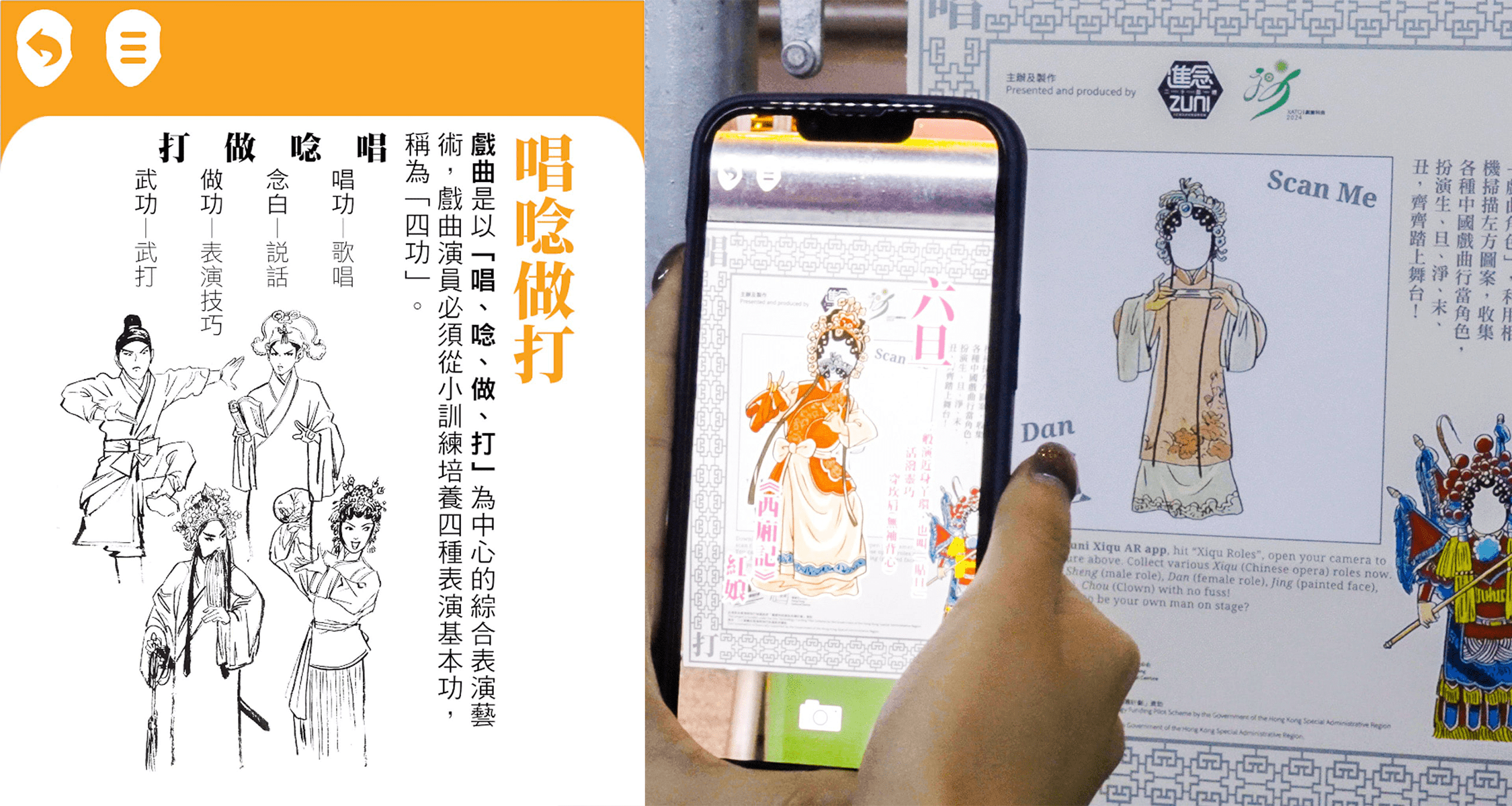

Zuni has specially launched a Xiqu mobile application to complement the programme, allowing audiences to explore traditional performing arts in an engaging and accessible manner. Through text, images, and video demonstrations, the app offers a multimedia pathway to understanding the art form.
A themed installation will be set up outside the theatre. Audiences are welcome to use the mobile application to scan the markers on the tags before or after the performance to discover surprises!
Supported Languages: Traditional Chinese, English, Simplified Chinese
Featured Content: Singing(Chang), Recitation(Nian), Acting(Zuo), Martial Arts(Da), Xiqu Roles, Xiqu Symbolism, Codification in Xiqu